Skip to product information
1 of 2

Hemlock & Honey

★★★★★ 4.98 from 63 Hemlock & Honey reviews

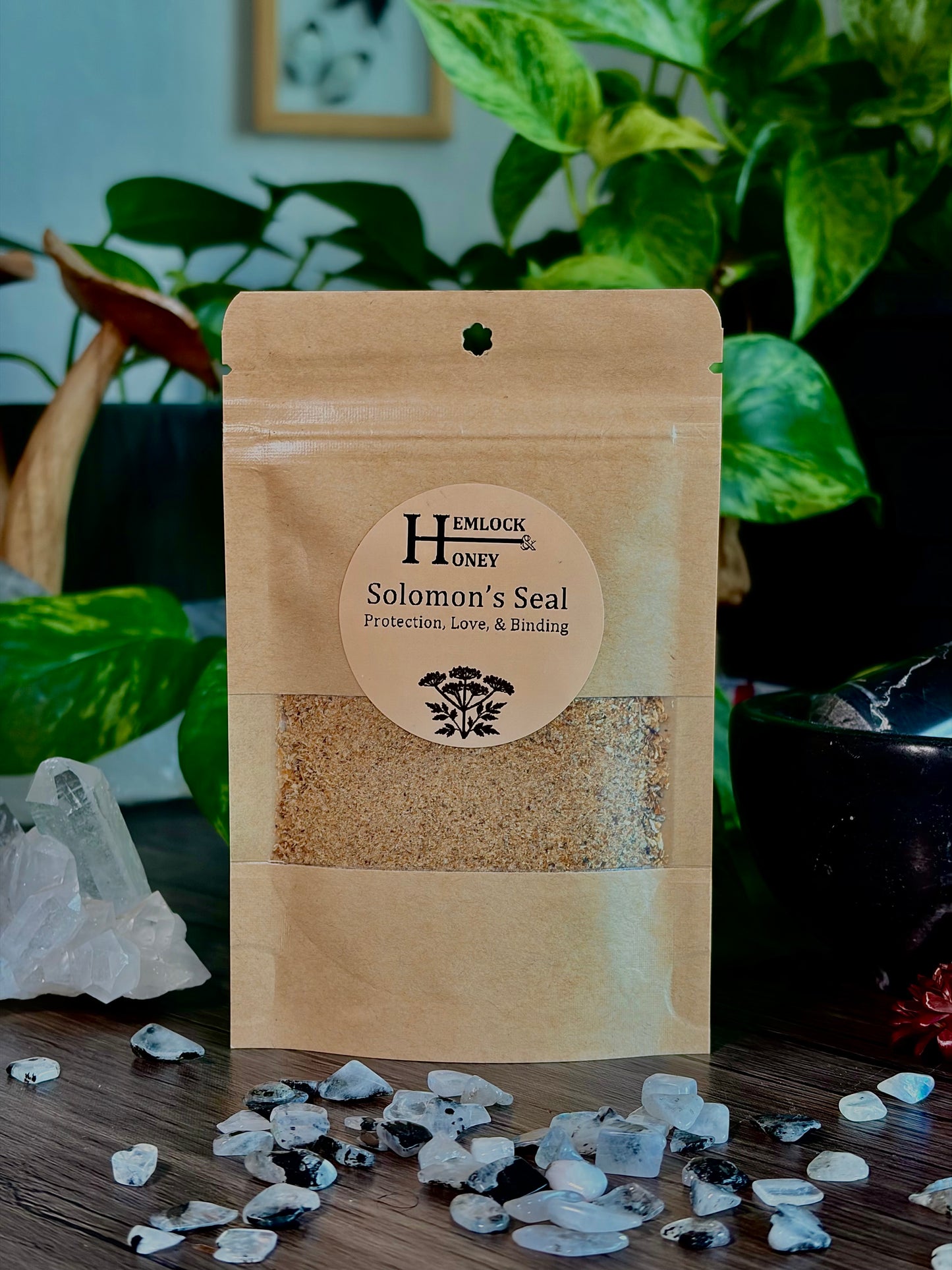
Solomon’s Seal for Protection, Love & Binding

Solomon’s Seal for Protection, Love & Binding

Size
Regular price $8.00 USD
Regular price Sale price $8.00 USD
Sale Sold out

Estimated delivery: Calculating...

1–3 business days processing

MIX & MATCH & SAVE
Buy any 3+ ritual herbs & save 10% automatically.
Shop Ritual Herbs →

Solomon’s Seal (Polygonatum spp.) is associated with protection, wisdom, sealing, and spiritual authority.

The root is especially suited to workings intended to close, secure, or protect something already established, with much of its magical character developing from the seal-like scars naturally left along its rhizome.

Disclaimer: This product is not intended to diagnose, treat, cure, or prevent any disease. Not for internal consumption. Sold as a curio.

Magical Uses

Protection & Warding: Used to establish and reinforce protective boundaries.

Sealing & Binding: Used to close, secure, or set a completed working.

Wisdom & Discernment: Associated with wisdom through its namesake, King Solomon.

Spirit Work: Used by some practitioners in workings involving spiritual authority, protection, or the commanding and constraining of spirits.

Ways to Work with Solomon's Seal

Place Solomon’s Seal Root at the boundaries or corners of a space as part of protective work.

Add it to a completed working when the intention is to symbolically seal and set what has been done. For jar workings, this herb can be added to the sealing wax.

Carry or incorporate the root into workings for wisdom and discernment.

Some practitioners also work with it where spiritual authority, binding, or the control of unwanted spirits is desired.

Folklore & Associations

Solomon’s Seal gets its name from the circular scars left on its underground rhizome as old stems die away.

These markings were compared to wax seals and the legendary Seal of King Solomon, giving the plant a connection to the biblical king famed for wisdom and, in later Jewish, Islamic, and Western magical traditions, authority over spirits.

The plant's physical “seal” also entered medicinal folklore through the Doctrine of Signatures, where its markings were interpreted as a sign that the root could “seal” wounds and broken tissues.

View full details